Stress testing.
Make the adverse case explainable.
Connect the scenario your team approves to the losses, earnings and capital it produces. Halden brings scenario design, reviewed models and results reporting into one traceable workflow for internal and supervisory exercises.
Answer the risk question. Keep the calculation behind it.
A severe scenario is only useful when a reviewer can explain its effect on the bank. Halden keeps macro paths, bank-specific overlays, model assumptions and reporting inputs visible at the point where they change the result. Reuse approved work in the next cycle and see which input or decision needs to be reviewed again.
The products in your workflow.
Build the scenario set
Use official macro series, historical crisis replay or explicit shocks. Review severity, timing and propagation, and keep observed paths separate from estimated reactions and bank overlays.
Translate paths into risk
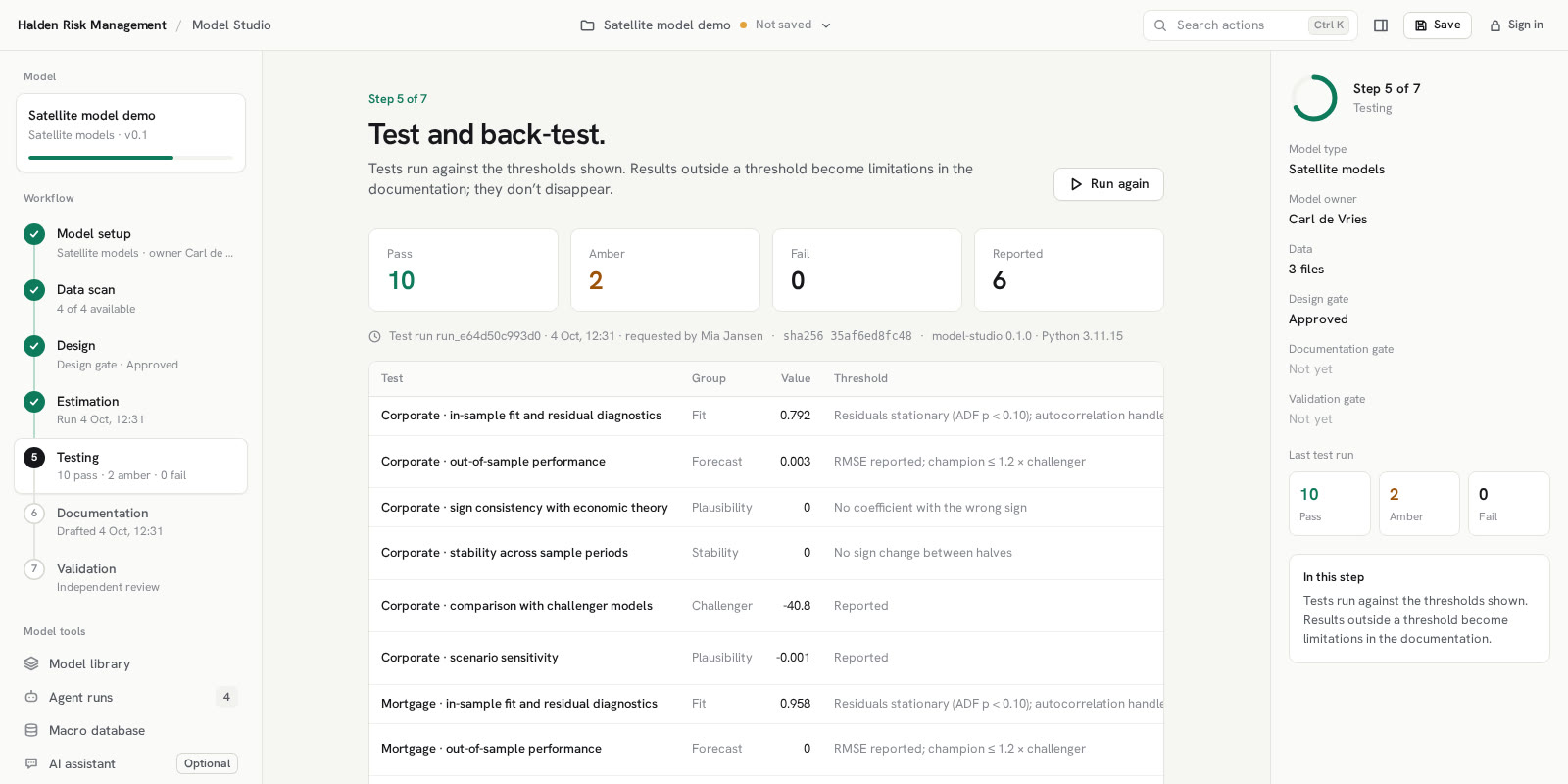
Develop and test satellite, credit and behavioural models with recorded design and validation decisions. Model runs retain the data and scenario version they used.
Review the capital impact
Combine scenario sets and model runs with the bank’s starting portfolio and own funds. Trace credit losses, available earnings components, the CET1 walk and headroom to their source.
Prepare the delivery
Export the signed report and its lineage. For an EBA exercise, combine the model and reporting hand-offs with bank mappings, validate them and write a new workbook.
Start from the inputs your team can stand behind.
| Input | What you bring | What to review |
|---|---|---|
| Starting portfolio and capital | Segmented exposures, own funds, REA, thresholds and the starting reporting date. | Missing inputs remain visible; a scenario alone does not produce a complete capital projection. |
| Risk models or model results | Model Studio runs, or outputs from the bank’s existing models supplied as external results. | NII, market and operational impacts enter the analysis when the relevant results are supplied. |
| Scenario and balance-sheet assumptions | Approved baseline and adverse paths, plus a balance plan where the internal exercise uses one. | Use a static or planned balance sheet according to the exercise. Do not silently mix their assumptions. |
Results with the evidence beside them.
Compare the paths
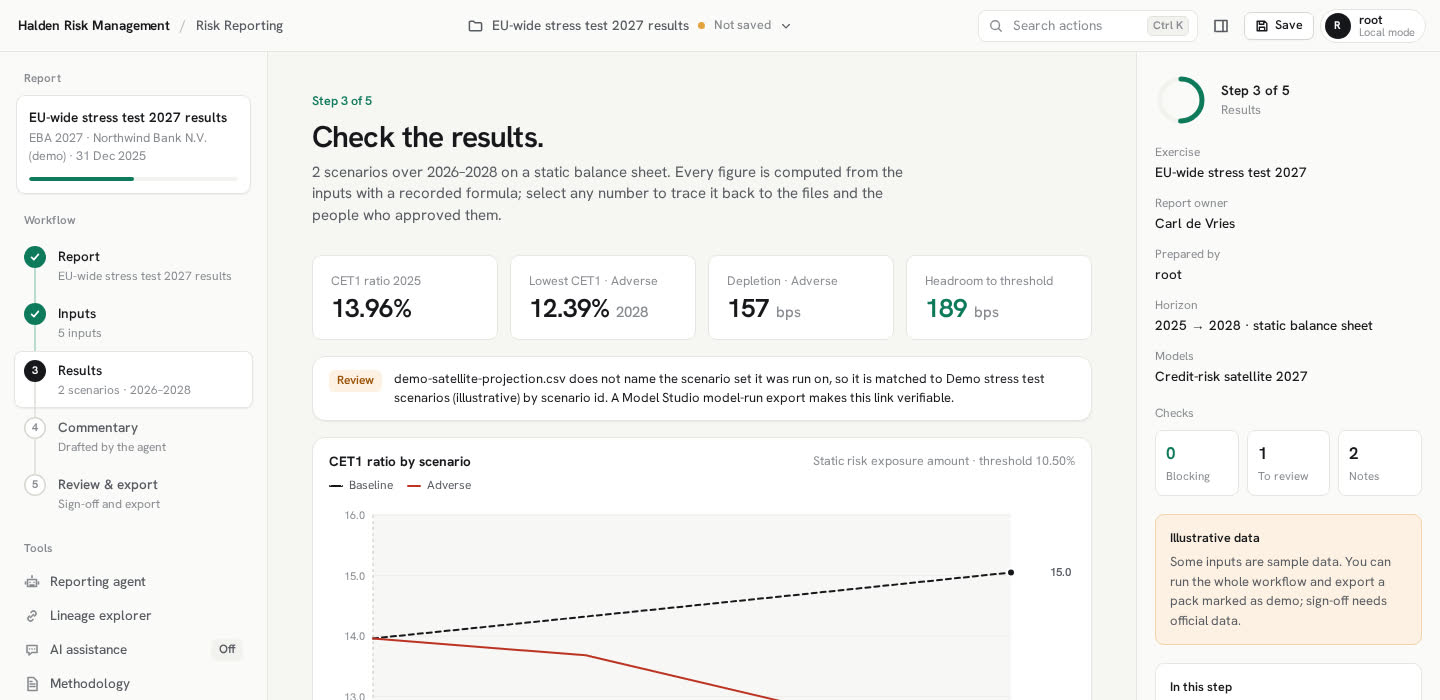
Review results by scenario, year and segment, including capital depletion, the lowest ratio and headroom against the bank’s threshold.
Explain the movement
Select a figure to see the formula and operands, input hashes and source model. Keep management-action what-ifs beside the underlying result.
Carry the evidence forward
Export the results pack, figures and lineage, or hand the approved outputs to EBA Filler. A changed input or result creates work for a new review.
People make the decision.
Approve the scenario set, review the model’s status and have the results report checked by a second person and signed by its owner. Unvalidated and external model results remain marked. Those labels help the reviewer decide whether an output is suitable for the exercise.
Exercise and supervisory context
Internal exercises and the EBA EU-wide stress test have different scopes, constraints and reporting requirements. Use the methodology and scenario specified for your exercise; Halden preserves the decisions and input versions used in the calculation.
Can we use our existing models?
Yes. Risk Reporting accepts results from models built elsewhere as external inputs. Model Studio runs additionally carry their scenario version, gates and approvers. The reviewer can distinguish both.
Does a historical crisis become a supervisory scenario?
A historical replay is an input to scenario design, not a substitute for the supervisor’s published scenario. Replay also depends on sufficient macro history; model-estimated reactions are separately tagged and can be switched off.
Bring your next stress-testing exercise.
Discuss the portfolio, model scope and reporting deadline. Start with one scenario and one portfolio, then review the whole calculation before expanding the pilot.