Climate risk.
From climate paths to financial risk.
Connect climate scenarios to transition exposures and flood risk at collateral locations. Keep the scenario source, bank assumptions and financial effects together as your team reviews the climate analysis.
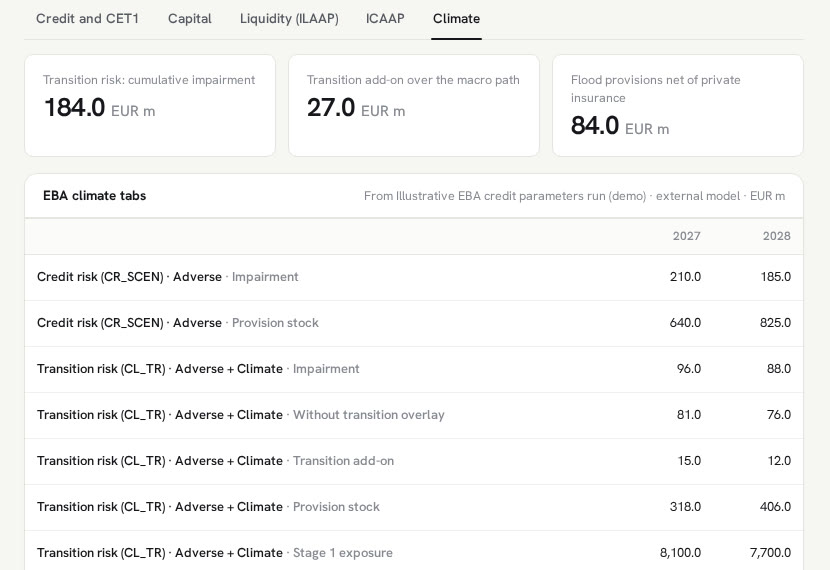
Make the transmission from climate to risk visible.
Climate analysis combines different horizons, datasets and assumptions. Halden keeps the climate path separate from the macro scenario, records the source of the inputs and shows how the chosen model turns them into an impairment or provision. A reviewer can follow the mechanism instead of accepting a single climate-risk score.
The products in your workflow.
Select and document the paths
Use the NGFS climate paths alongside the macro baseline and adverse scenario. Record the chosen horizon and any bank overlay. Stand-in scenarios keep their explicit demonstration labels.
Connect exposures to risk drivers
Use the EBA climate workflow to connect sector and energy-label transition inputs and collateral flood exposure to the model. The hazard library provides JRC flood maps and location lookups for the supported areas.
Compare the financial effects
Review transition impairment, the add-on over the macro path and flood provisions, including gross and net effects where insurance and public-scheme inputs are supplied.
Keep the report and template aligned
Use the model and reporting hand-offs in the EBA draft climate tabs. Combine them with the bank’s remaining inputs and review findings before generating the delivery.
Start from the inputs your team can stand behind.
| Input | What you bring | What to review |
|---|---|---|
| Transition exposures | The bank’s exposure breakdown and the sector, counterparty or energy-label attributes used by the selected model. | Missing classifications and model assumptions need an explicit treatment; public scenario data does not replace bank exposure data. |
| Collateral locations | Locations in the supported lookup scope, plus the exposure and collateral information needed for the flood calculation. | Review location quality and hazard coverage. A mapped flood hazard alone is not a loss estimate. |
| Protection and scenario choices | Insurance or public-scheme inputs where applicable, chosen NGFS paths and any bank-specific adjustments. | Record gross and net effects separately, and review assumptions for the horizon you are analysing. |
Results with the evidence beside them.
Transition effects
Inspect the model’s transition impairment and its additional effect over the macro scenario, with the source model and its review status visible.
Physical-risk effects
Review flood provisions and the influence of location, hazard and supplied protection assumptions. Keep input gaps available to the checker.
A consistent reporting hand-off
Use the same climate run in the results report and EBA Filler delivery. Follow a reported amount back to the model output and its source files.
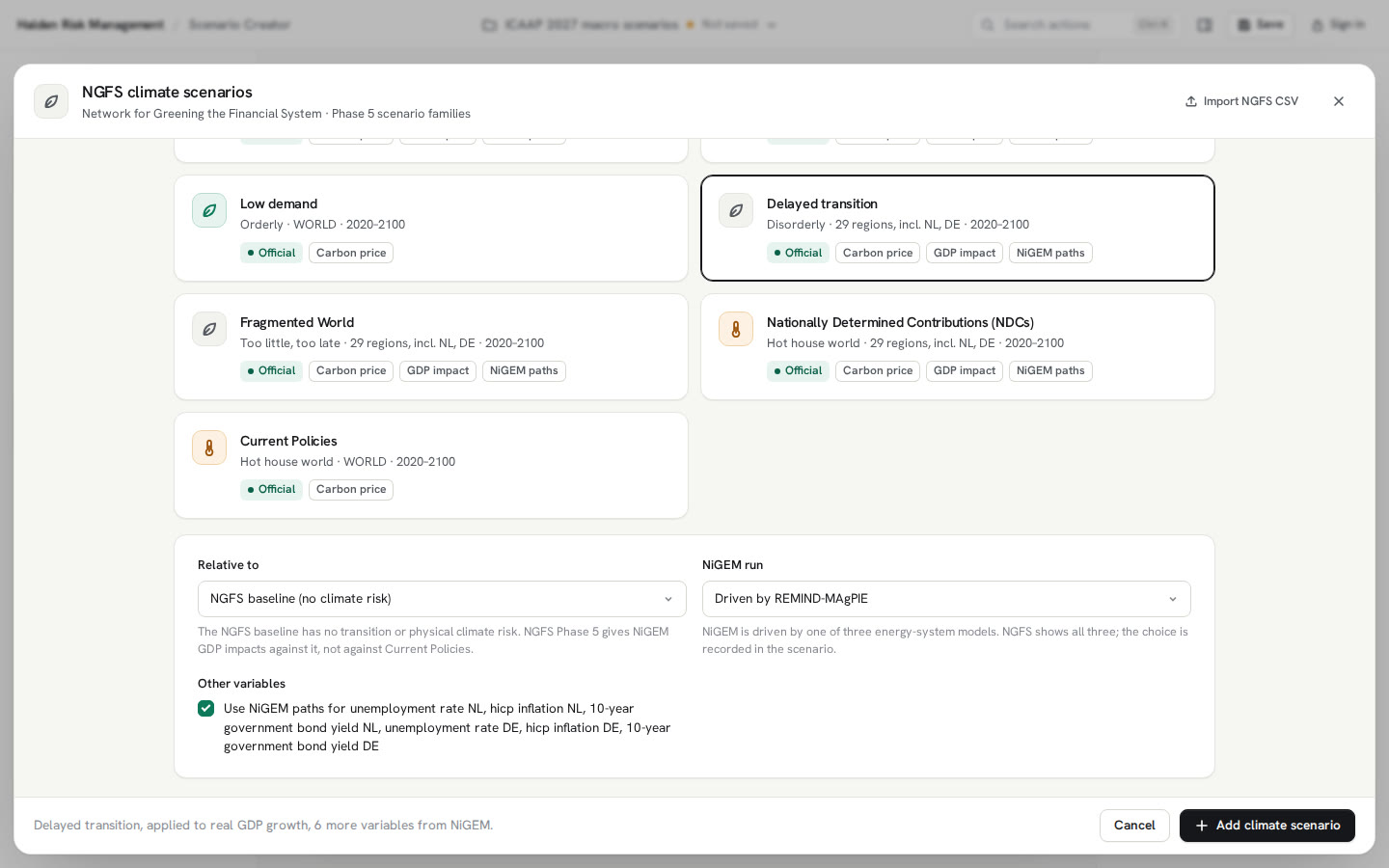
People make the decision.
Review the relevance of the scenarios to the bank, the quality of exposure and location data, and the model limitations. Separate published data, illustrative assumptions and bank overlays. Halden’s current physical-risk workflow focuses on flooding; other hazards require separate data and a supported modelling approach.
Exercise and supervisory context
The ECB treats climate-related and environmental risk as relevant to a bank’s existing risk categories. The EBA 2027 draft materials introduce climate components into the EU-wide stress-test workflow. The pages and recorded demonstration describe that draft workflow, rather than a guarantee of coverage of every hazard or supervisory requirement.
Does NGFS provide a bank-specific loss estimate?
No. NGFS provides scenario pathways. Financial effects depend on the bank’s exposures, classifications, modelling choices and protection assumptions. Halden keeps those choices visible with the result.
Can we analyse climate outside an EBA exercise?
Scenario Generator provides NGFS paths and bank overlays for internal analysis. Reuse the model outputs that fit your purpose and explain their scope. EBA-specific template calculations must be assessed before being used for another horizon or exercise.
Start with the climate exposures that matter.
Bring the relevant portfolio, location coverage and intended horizon. We can demonstrate the supported transition and flood workflow and agree the data gaps to resolve in a pilot.