Risk models, built compliantly.
With agents doing the groundwork.
Model Studio is our model platform. It starts from the data your institution actually has: agents scan it, propose a methodology that fits, then estimate, test and document the model. Named people approve every decision that matters.
model types, each with its methodology published on this site
steps from setup to validation, run by agents up to each gate
gates, each bound to the exact version a person approved
figures sent to Halden. The engine runs on your computer
Agents run every step up to a gate. Then they stop and wait for a person.
Scan what exists.
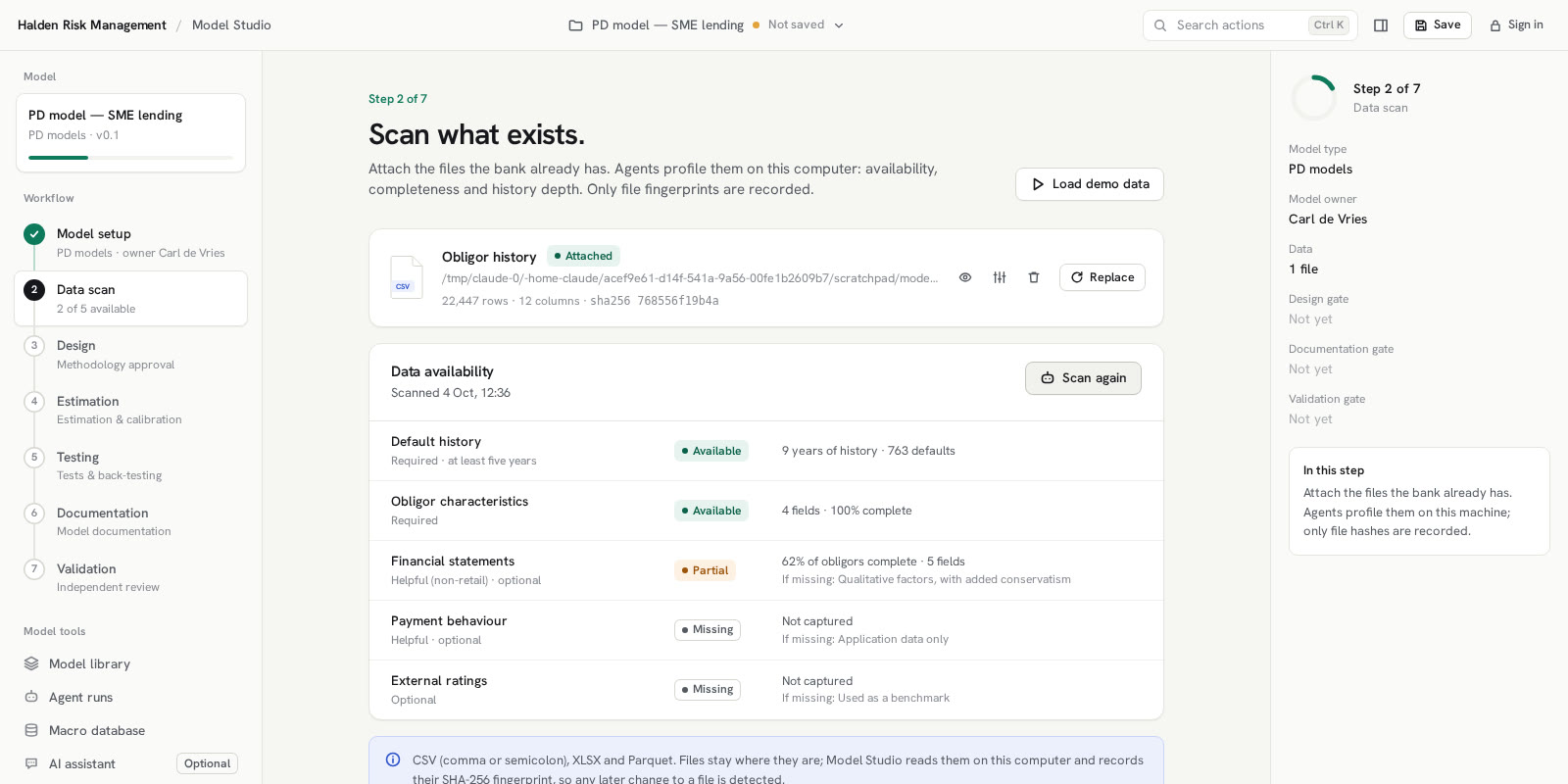
Attach the files the bank already has. Agents profile them on this computer against what the chosen method needs: which fields exist, how complete they are and how far back they go.
- CSV, XLSX and Parquet, read where they are; only a SHA-256 fingerprint is recorded
- Each required field marked Available, Partial or Missing
- Every gap shown with what the method does instead
Agents propose. You decide.
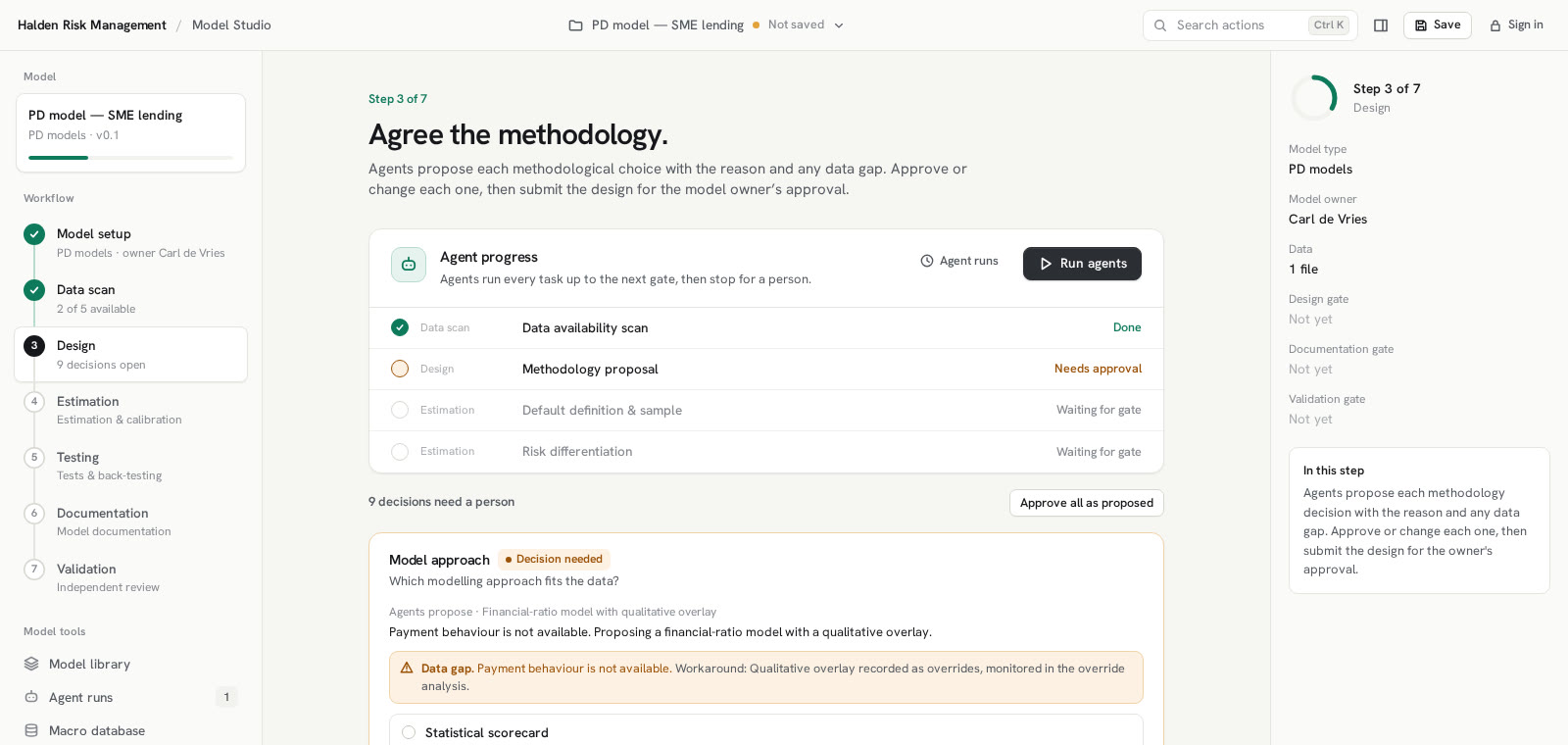
Each methodological choice arrives as a proposal with its reason and any data gap: the approach, the sample, the drivers, the master scale, the margin of conservatism. Approve or change each one, then submit the design to the model owner.
- Nine decisions for a PD model, six for a satellite model
- The owner approves the design gate before anything is estimated
- The approval binds to that exact design; a later change supersedes it
Build and calibrate.
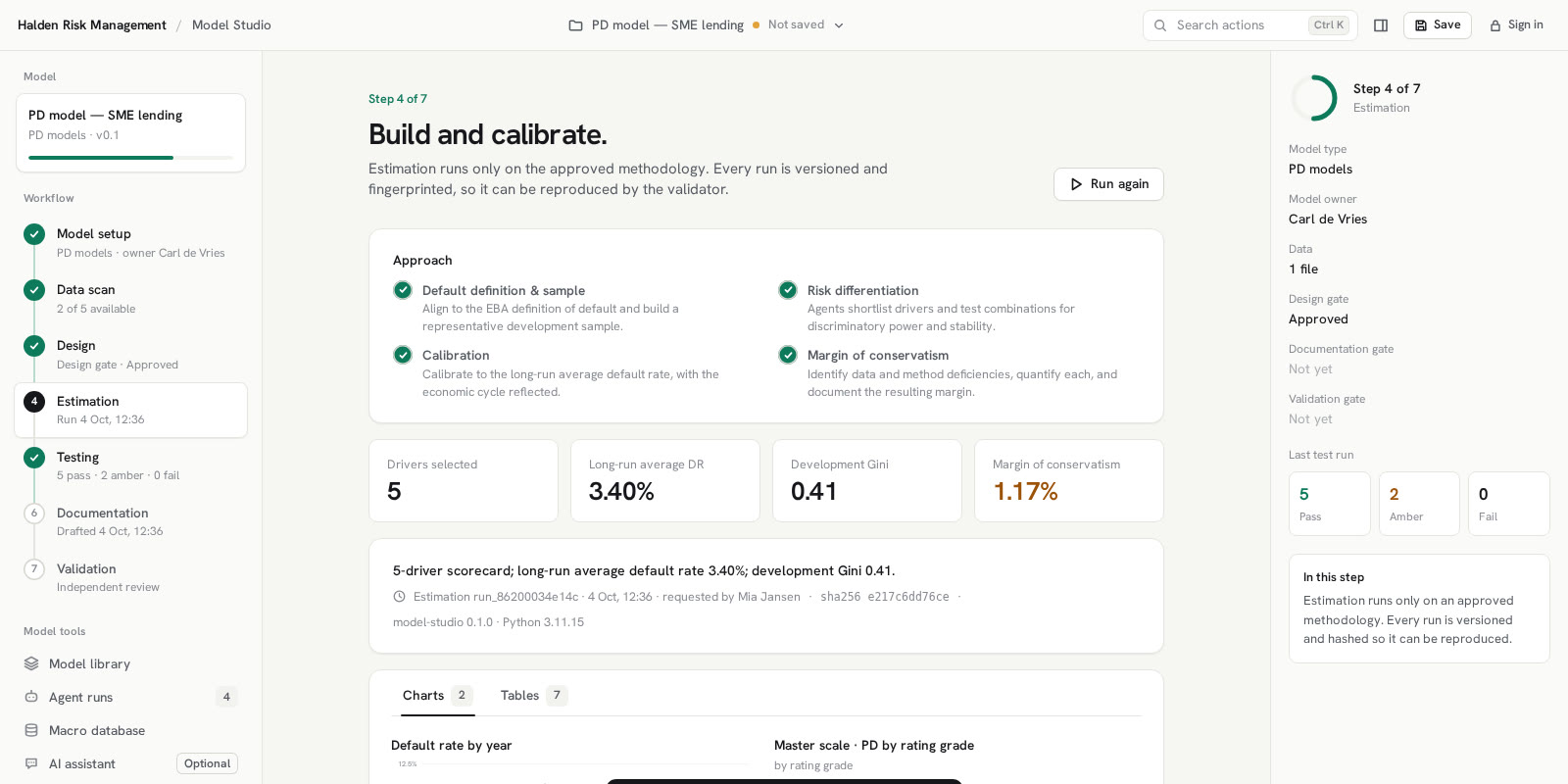
Estimation runs only on the approved methodology, in a Python engine on your computer. Every run is versioned and fingerprinted, so the validator can reproduce it exactly.
- numpy, pandas, scipy and statsmodels; no cloud compute
- Charts and tables recorded with each run
- Run again at any time; earlier runs are kept
Test and back-test, in plain view.
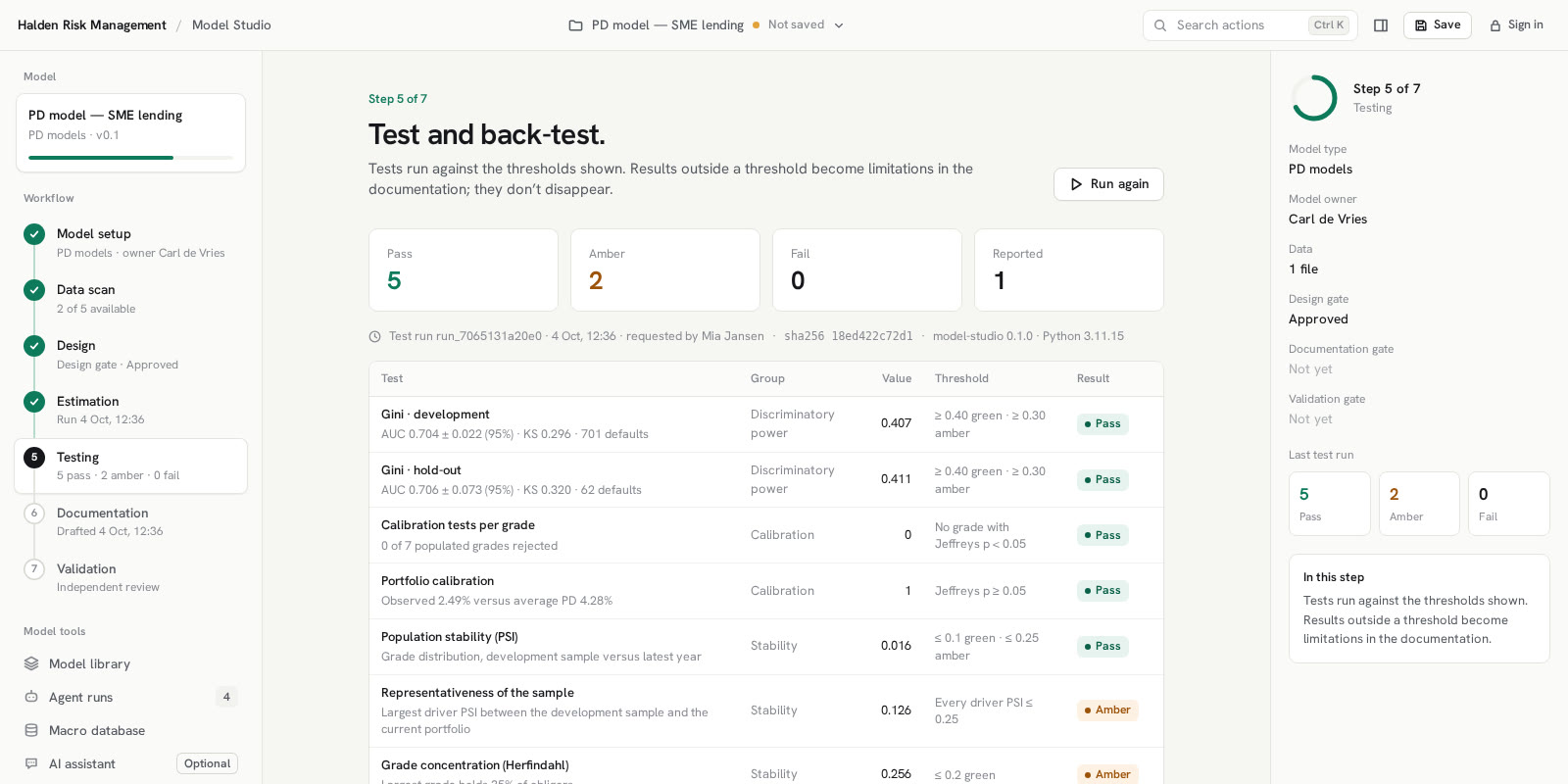
Each test runs against the threshold shown beside it. A result outside its threshold is not hidden or rounded away: it becomes a stated limitation in the documentation.
- Discriminatory power, calibration, stability and representativeness for PD
- Fit, out-of-sample, sign and stability tests for satellite models
- Pass, amber, fail or reported, with the reason for each
Documentation, written from the runs.
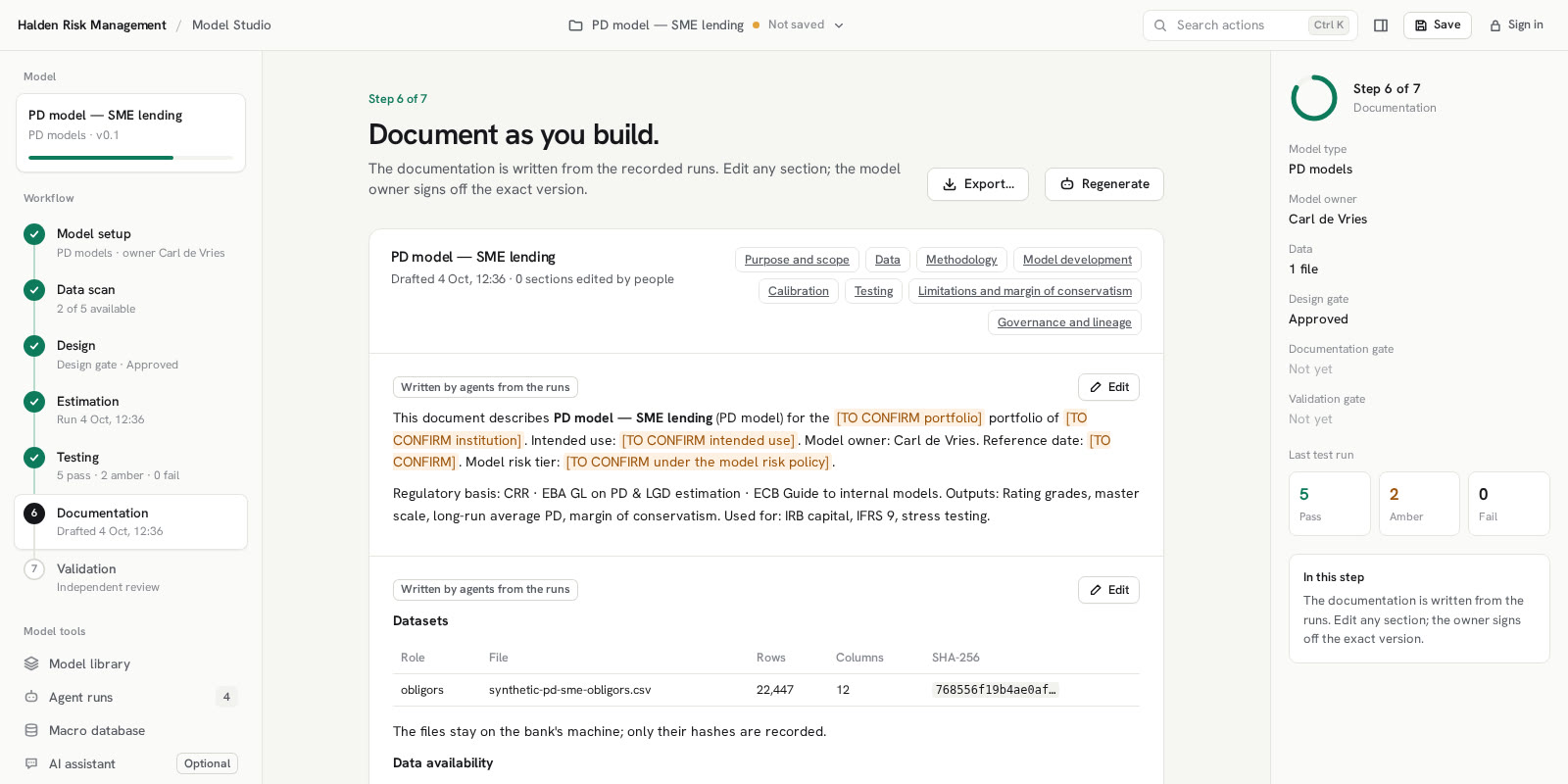
Model Studio drafts the model documentation from the recorded data, decisions, runs and tests. Edit any section. The model owner signs off the exact version.
- Export as HTML or Markdown
- A model card in JSON with decisions, runs, tests, gate records and the audit head
- Open points marked for your team to confirm
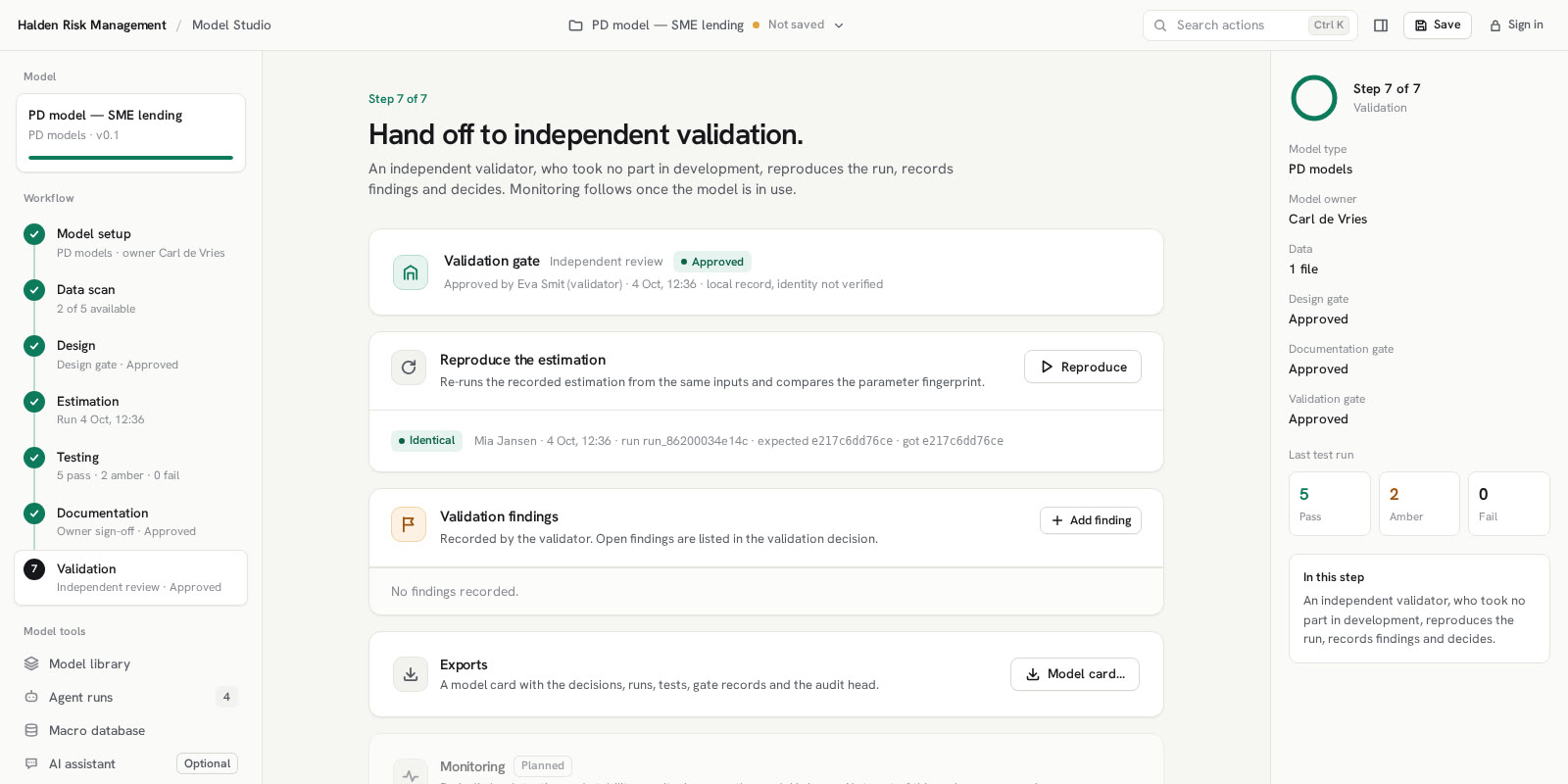
Handed to an independent validator.
Someone who took no part in development reproduces the estimation, records findings and decides. Their decision is recorded with the evidence it was based on.
- The validator cannot have developed the model
- Reproduction compares the parameter fingerprint
- Every gate, decision and run in a hash-chained audit log
A model that fits your data. Not a template that assumes data you don't have.
Scan what exists
Agents profile the bank's data: what is available, how complete it is, and how far back it goes.
Propose a methodology
A model design that fits the data and the regulation, with every gap and workaround stated.
Build and calibrate
Variable selection, segmentation, estimation and back-testing. Every run is versioned and can be reproduced.
Document and hand off
Documentation drafted from the recorded runs as the model is built, then signed off and handed to an independent validator.
Agents do the work.
People make the decisions.
Every methodological choice is a decision for your modellers. Agents propose and execute, then stop at the next gate. Only a named owner or an independent validator can open one, and AI never can.
These are the frameworks each method is designed around. They are not a statement of compliance: your own validation decides that.
These are the frameworks each method is designed around. They are not a statement of compliance: your own validation decides that.
The models behind every risk number. Six types today, each with its method published.
PD models
Scorecards and rating models, through-the-cycle and point-in-time.
Model details →LGD models
Workout and cure-based LGD, including downturn adjustments.
Model details →EAD & CCF
Credit conversion factors for revolving and off-balance exposures.
Model details →IFRS 9 ECL
Lifetime PD term structures, staging and macro scenarios.
Model details →Satellite models
Macro-to-risk links for stress testing and climate scenarios.
Model details →Behavioural models
Prepayment and non-maturing deposits for IRRBB and NII.
Model details →Any model type
Your own model types on the same lifecycle, gates and audit trail, beyond the six above.
Built-in code editor
Write and version your own estimation code inside Model Studio, with runs recorded like any other.
Monitoring
Periodic back-testing once a model is in use, feeding the next validation.
Scenarios in, projections out. One chain from macro data to the stress test template.
Scenario sets from Scenario Creator
Checked on import: content hash, approval status and whether any path uses illustrative data, all shown before use.
Scenario Creator →One macro database
Public series from the ECB Data Portal, or ECB files you import. Satellite models use it as their macro history.
Projections for the EBA Filler
Satellite projections export as CSV, ready to map into the stress test template with the same lineage.
EBA Filler →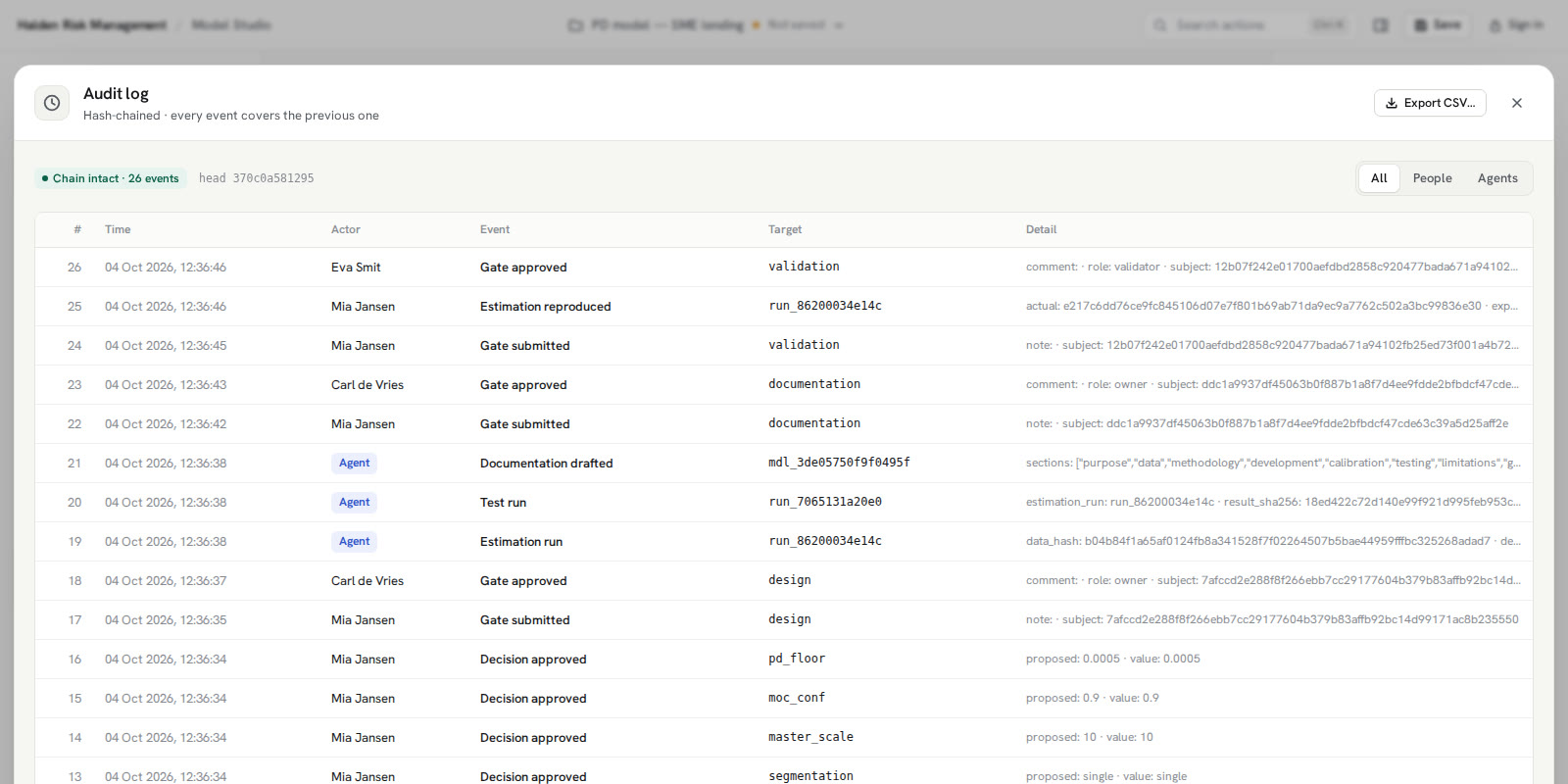
Version 0.1.0. Here is what that means.
- In version 0.1.0
- Six model types, seven steps, three gates
- Local mode with no account, or team mode on the Halden server
- Synthetic demo data for every model type
- Documentation, model card and CSV exports
- Good to know
- The demo data is synthetic, so its results are illustrative
- Generated documentation marks the text your team still has to confirm
- Any model type, a code editor and monitoring are planned, as shown above
Any model type
Your own model types on the same lifecycle, gates and audit trail, beyond the six above.
Built-in code editor
Write and version your own estimation code inside Model Studio, with runs recorded like any other.
Monitoring
Periodic back-testing once a model is in use, feeding the next validation.
Scenarios in, results out. One chain from public macro data to the report and the template.
Scenario sets from Scenario Creator
Checked on import: content hash, approval status and whether any path uses illustrative data, all shown before use.
Scenario Creator →The European macro library
Official series for 33 European areas ship with the app, shared with Scenario Creator. Satellite models use them as macro history; IMF projections and NGFS paths are shown for reference only.
Macro library →Run results for Risk Reporting
Each result is bound by hash to its data, scenario set, gates and audit trail, and marked as not validated until the validator approves.
Risk Reporting →Projections for the EBA Filler
Satellite projections export as CSV, ready to map into the stress test template with the same lineage.
EBA Filler →Version 0.1.0. Here is what that means.
- In version 0.1.0
- Six model types, seven steps, three gates
- Local mode with no account, or team mode on the Halden server
- Synthetic demo data for every model type
- The European macro library, built in
- The EBA 2027 starting point: your Actual 2025 and 2026 figures for four credit tabs, checked against the template and approved four-eyes
- Run results for Risk Reporting, documentation, a model card and CSV exports
- Good to know
- The demo data is synthetic, so its results are illustrative
- Generated documentation marks the text your team still has to confirm
- Any model type, a code editor and monitoring are planned, as shown above