ICAAP & ILAAP.
Capital and liquidity, in one view.
Connect your risk inventory, scenario results and funding assumptions to the internal capital and liquidity assessment. Halden keeps both the figures and the decisions visible as the report moves through review.
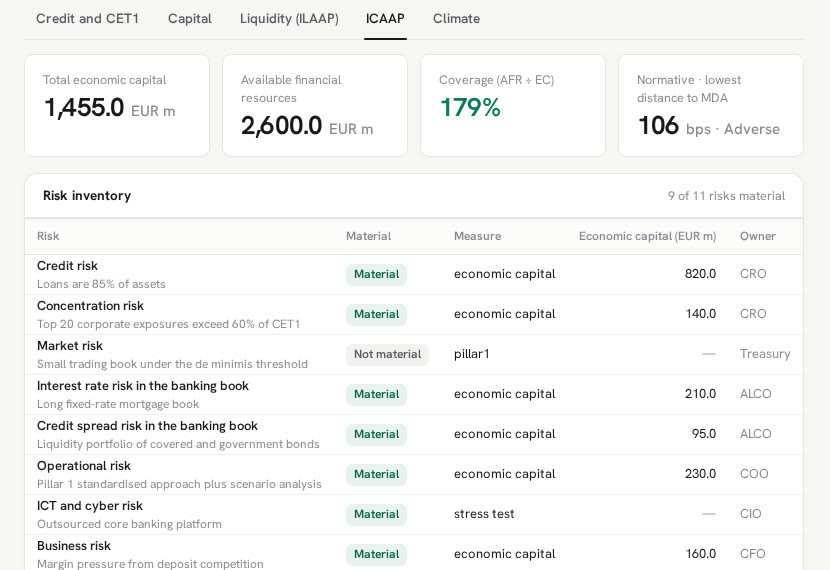
A report built from the assessment behind it.
Capital ratios tell one part of the story; the risk inventory and funding stresses tell another. Halden brings these views into the same reporting workflow, with named risk owners and the source of each figure recorded. The bank remains responsible for its risk appetite, materiality decisions and management-body assessment.
The products in your workflow.
Set the scenarios and assumptions
Build the macro scenarios and explicit bank overlays used in the internal assessment. Link the chosen horizon and balance-sheet assumptions to the bank’s vulnerabilities and planning needs.
Supply the risk measurements
Use Model Studio runs for supported risk measures and behavioural assumptions. Bring the bank’s own economic-capital figures where needed, with their external origin and limitations visible.
Assess capital and liquidity
In Risk Reporting, compare the normative capital projection and economic-capital view. Review liquidity ratios, stress survival horizons and the funding plan alongside the same scenario assumptions.
Prepare an EBA hand-off when needed
ICAAP and ILAAP results are reviewed and exported in Risk Reporting. If the work also feeds a separate EBA stress-test delivery, EBA Filler maps the relevant supported outputs into that workbook.
Start from the inputs your team can stand behind.
| Input | What you bring | What to review |
|---|---|---|
| Risk inventory and appetite | Risks, materiality, owners, measurement approach, limits and the bank’s economic-capital figures or model runs. | Record unmeasured material risks and the rationale for any diversification benefit; the software does not choose the bank’s risk appetite. |
| Capital and balance plan | Own funds, REA, requirements and buffers, projected earnings and any agreed balance-sheet plan. | Use the bank’s applicable thresholds. Keep management actions visible as separate what-ifs. |
| Liquidity and funding data | Liquidity-buffer assets, inflows and outflows, funding assumptions, deposit behaviour and counterbalancing capacity. | Review the data and stress assumptions before relying on LCR, NSFR or survival-horizon results. |
Results with the evidence beside them.
Capital adequacy in both views
Review ratios and requirement headroom alongside economic capital and available financial resources. Figures supplied by the bank remain distinguished from model-run results.
Liquidity under stress
Compare idiosyncratic, market-wide and combined stresses, the survival horizon and the funding plan. Add behavioural-model deposit run-off where it is available.
A report the owner can review
Draft commentary from the figures, edit and accept each section, then take the exact report version through checker and owner sign-off. Export the pack, figures and lineage.
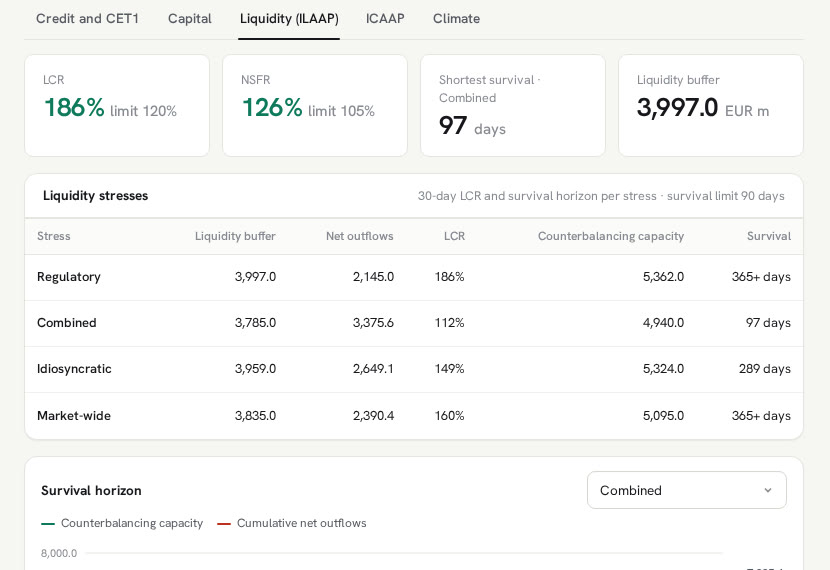
People make the decision.
The institution defines its inventory, materiality and internal assessment framework. Halden supports the calculations and review evidence; a generated report is not the whole ICAAP or ILAAP process. The reviewer checks the exact version, and the owner signs after the commentary and figures are accepted.
Exercise and supervisory context
The ECB’s ICAAP and ILAAP guidance distinguishes complementary normative and economic perspectives. Capital and liquidity assessment also involves governance, strategy and management decisions. Halden helps prepare the figures and evidence used in that process; it does not make those decisions for the institution.
Does Halden decide which risks are material?
No. Materiality, risk ownership, appetite and measurement choices belong to the institution. Record them in the risk inventory and supply the associated measures. Missing or externally supplied figures stay visible.
Do we need EBA Filler for ICAAP or ILAAP?
No. Risk Reporting prepares and exports the internal capital and liquidity report. EBA Filler is only relevant when supported outputs also feed a separate EBA template delivery.
Bring the assessment your board needs to review.
Discuss the risk inventory, capital plan, funding stresses and existing models. A focused pilot can show how the figures, commentary and review evidence fit into your current assessment process.